

Encompassing treatment centers at both St. Peter’s Hospital in Albany and Samaritan Hospital in Troy, St. Peter’s Health Partners (SPHP) Cancer Care has been providing advanced cancer care to patients in the greater Capital Region for more than 40 years. From outpatient chemotherapy and immunotherapy to surgical consultations and second opinions, the cancer team at SPHP strives to deliver patient-centered care during a time when it’s needed the most, directly within patients’ own communities.
“First and foremost, we can’t take a diagnosis of  cancer away from a patient. But what we can do is make sure that the patient and their family and caregivers are not going through the journey alone,” said Nicholas Montalto, MD, Chief Medical Officer for SPHP Acute Care. “What we try to do is provide compassionate, evidence based care from the moment of diagnosis through treatment and recovery,” which includes a dedicated support structure to help patients and their families process their diagnosis, understand treatments, and even receive assistance with out-ofpocket expenses like transportation and housing costs.
To accomplish this goal, SPHP offers a multi disciplinary, team approach involving medical oncologists, radiation oncologists, surgeons, nurses, pharmacists, social workers, rehabilitation specialists and palliative care specialists, Dr. Montalto explained.
 Working together, these care providers offer treatments for a broad range of cancers and blood diseases, including breast cancer, colorectal cancer, gastrointestinal cancer, gynecologic cancer, head and neck cancer, lung cancer, and urologic cancer. Early detection and preventive measures are key – SPHP works with primary care physicians to
provide free cancer screenings, as well.
“The cancer care programs at St. Peter’s have been running for more than 40 years and are designed to offer a variety of services. In addition to the medical oncology and hematology program, we have a fantastic program of surgeons providing thoracic surgery, breast surgery, genitourinary surgery, and hepatobiliary surgery,” said John Weinhold, MD, acting Chief of Hematology Oncology Services at SPHP.
Enhanced Access to Nationally Ranked Care
 Recent advancements in cancer care at SPHP demonstrate the organization’s commitment to providing patients with cutting-edge treatments and advanced care directly within their communities.
Last year, St. Peter’s Health Partners Medical Oncology announced that it is now a member of the Roswell Park Care Network, affording patients access to a nationally designated comprehensive cancer center.
This partnership with Roswell Park Comprehensive Cancer Center has brought access to front-line cancer expertise, advanced diagnostics, and innovative treatment options for patients across the Capital Region, as Dr. Montalto explained.
 “Our partnership with Roswell Park has been one of the most exciting things, I think, to happen to St. Peter’s Health Partners. This affiliation with a comprehensive, nationally ranked, premier cancer center gives us access to everything a comprehensive cancer center offers. That can be access to clinical trials, to even more cutting-edge technology, and access to all the physician talent that exists at such a renowned cancer center,” Dr. Montalto said.
Through this connection to Roswell Park, SPHP has gained access to educational programs, medical grand rounds, and surgical grand rounds, as well, Dr. Weinhold explained. Clinical trials and research programs are essential for investigating the newest and best cancer treatments, and through the Roswell Park Care Network, providers and patients at SPHP can become involved in clinical trials as well as genomic and genetic testing, multidisciplinary case reviews, and advanced clinical pathways for more personalized cancer treatments. Along with a switch from emphasis on chemotherapy to more targeted therapies and immunotherapies based on patients’ personal genetic and molecular abnormalities, “we now have many treatments which are much easier to administer at home,” said Dr. Weinhold.
Many providers just coming out of training programs are increasingly concentrating on cancer sub-specialties, Dr. Weinhold also explained. The partnership with Roswell Park has increased SPHP’s access to networks of providers who are attuned to a wide range of specific cancers.
 “With the connection with Roswell, we can speak with people who see a particular range of cancers, so for example, we can talk with someone who treats sarcomas, which are uncommon cancers. We can talk with someone who treats very unusual blood diseases. We
can take advantage of this connection and provide more coordinated care for patients to be seen by sub-specialists at Roswell. I think that offers a step up in care,” said Dr. Weinhold.
Utilizing Precision Robotics for Earlier Cancer Detection
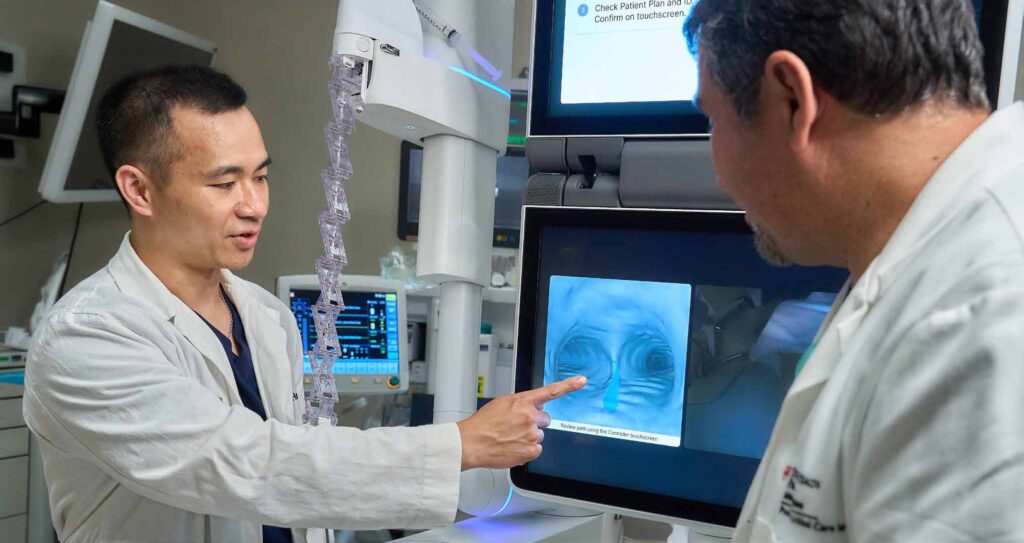
Along with the exciting partnership with Roswell Park, SPHP has also recently obtained cutting edge technology that has allowed certain kinds of cancer to be detected at earlier stages. Pulmonologists and surgeons at SPHP can now use the ION Robotic System from Intuitive Surgical: a state-of-the-art, roboticassisted platform that provides minimally invasive biopsies of small, hard-to-reach lung nodules without an incision or needle through the chest wall. The first case using the ION robot was performed in a special endoscopy suite at Samaritan Hospital on June 12.

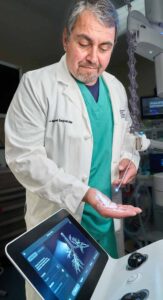
“ION bronchoscopy enables computer and robotic-assisted, highly accurate biopsies to be performed through the airway while the patient is sound asleep and comfortable. It allows us to place small coils that glow in the dark for about two weeks, facilitating identification of half-inch nodules in the operating room with infrared light. This process allows much earlier diagnosis and minimally invasive treatment using the da Vinci robot. Most of our patients who require lung surgery can now go home one day after surgery,” said Tracey Weigel, MD, a thoracic surgeon who recently joined Albany Thoracic & Esophageal Surgery. She utilizes the ION robot along with Joseph Seguel, MD, a pulmonologist with Pulmonary & Critical Care Services.
Dr. Seguel emphasized the impact the ION robot has made by allowing for faster, more accurate diagnosis, which is critical because lung cancer remains the leading cause of death in the U.S. and delay in diagnosis leads to a documented upstage in the disease. He also explained that procedures using the ION robot are much safer than previously used methods.
“Traditional methods of diagnosis include regular bronchoscopy and navigational bronchoscopy, which rely on creating a ‘breadcrumb’ trail to the abnormal CT finding – typically a nodule,” said Dr. Seguel. “ION offers a more stable option to get biopsies in a much safer way,” with CT-guided biopsy carrying an approximately 20% risk of lung injury, compared to the ION robot’s 5% risk of injury. Additionally, multiple locations can be sampled in one procedure, and additional testing to rule infections can be performed at the same time.
The ION robot also represents a strong partnership between the thoracic surgery and pulmonology teams at SPHP, as biopsies by the pulmonologists result in peripheral nodules being marked and ready for minimally invasive surgery within two weeks.
“Planning for procedures while evaluating airways and targets is a new collaborative effort to help deliver the best care to patients,” said Dr. Seguel.
Targeted Treatment with Decreased Side Effects
Another important advancement in cancer care at SPHP involves technology that’s not necessarily new, but that is now being used alongside enhanced imaging technology to provide direct benefits to a segment of patients diagnosed with prostate cancer. St. Peter’s Hospital and Capital Region Urology have begun utilizing High-Intensity Focused Ultrasound (HIFU) technology to provide minimally invasive prostate cancer treatments. While HIFU has existed for over 20 years, the technology, which uses targeted ultrasound waves to destroy cancer cells without incisions or radiation, is now being paired with more precise imaging scans to provide significant benefits for patients.
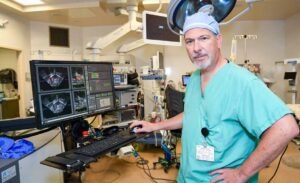 “HIFU has been used in the U.S., but its success has been variable,” said Brian Murray, MD, Chief of Urology at St. Peter’s Hospital. “There’s a new technology called PSMA PET scans, which are incredibly good at finding localized prostate cancer. We don’t want to treat someone with HIFU, or focal therapy, if there’s disease in many parts of the prostate, or if it’s already spread outside the prostate. The system we have now lets you really steer the focused ultrasound very accurately in the prostate to carve out this limited area where you know the cancer is. This series of advancements in technology has allowed this to become a mainstay treatment for people who have localized prostate cancer,” which is about 35% of men who have prostate cancer and need treatment.
The procedure using HIFU takes about two hours and is done under anesthesia in the hospital, Dr. Murray explained. Afterward, patients tend to experience very little pain or voiding symptoms. HIFU is approved to treat benign disease of the prostate as well as prostate cancer. Importantly, the treatment preserves healthy surrounding tissue and typically doesn’t leave patients with life-altering side effects like urinary incontinence and erectile dysfunction, which are more commonly experienced when the entire prostate is removed or radiated, Dr. Murray explained.
 “By treating just part of the prostate, we avoid coming in contact with the nerves that lay just outside of the prostate, or which run through the prostate,” Dr. Murray said. “This means the treatment isn’t leaving patients with incontinence or erectile dysfunction, which are two of the main concerns men have when they decide to treat their prostate cancer.”
Since last fall, there have been more than 25 HIFU procedures performed at SPHP, and demand for this minimally invasive surgery is increasing as awareness of its availability grows. “With the data coming in now about outcomes, HIFU needs to be part of the treatment discussion. It won’t be suitable for every patient, but for the men who are candidates for this prostate-sparing surgery, the outcomes are huge regarding quality of life,” said Dr. Murray. “Being able to offer patients something that can treat the cancer and reduce side effects is really opening doors for a lot of people.”
Continued Investments in Patient-Centered Cancer Care
While HIFU technology has trickled down from other cancer applications to the treatment of prostate cancer, SPHP is continuing to invest in ultrasound technology for expanded urological treatments, as well. Whether it’s regarding robotics, targeted ultrasound treatment, or partnering with leading nationwide cancer care experts, investing in new technologies that benefit patient outcomes appears to be a common theme at SPHP.
“Dr. Hanks [President and CEO of SPHP] has been a strong advocate of robotics for SPHP. He has always supported the implementation of new technologies to help deliver care with cutting edge technology,” said Dr. Seguel.
Of course, all advancements in care come down to how patients are directly benefited when they come to SPHP and receive care in their own communities.
“People like coming to our cancer centers because they’re comfortable, peaceful places to get treatment,” Dr. Weinhold said.
“It’s all about access,” added Dr. Montalto. “Allowing patients to stay in the community where they live and feel their strongest support is so important.”
