
Open since May 2025, the practice takes an integrated approach to ensure patients and providers have streamlined access to medical records. This connectivity through the St. Peter’s Health Partners EMR makes care more seamless and communication easier.
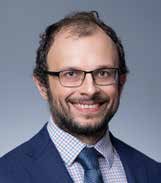
 “Our goal is simple: to give patients access to the latest orthopedic innovations as we provide quality and efficient care centered around each patient’s needs,” said Imran Akhtar, DO, who founded the practice with Hamza Murtaza, MD.
Accessibility
St. Peter’s Orthopedics in Latham has expanded from its two founders to a staff of six physicians and two advanced practice providers. Each doctor brings his own sub-specialty to the practice.
“That expansion is due to demand, but we also wanted to make sure we offer every sub specialty,” said Dr. Akhtar, DO. “Now we can provide comprehensive musculoskeletal care from the spine, shoulders, and hands, to hips, knees, foot and ankles.”
The orthopedic practice is a part of St. Peter’s Health Partners Medical Associates, which is a division of St. Peter’s Health Partners. The medical group includes more than 1,100 physicians and advanced practitioners in more than 130 locations around the Capital Region.
St. Peter’s Health Partners is the region’s largest and most comprehensive, notfor- profit network of high-quality, advanced medical care, primary care, rehabilitation, and senior services. It is a member of Trinity Health, one of the nation’s largest Catholic health systems, operating 92 hospitals in 25 states.
 Making It Easy for Patients
Additionally, St. Peter’s Orthopedics offers an orthopedic walk-in clinic Mondays through Fridays from 8 a.m. to 4 p.m. at the Latham location.
“The clinic has been a huge draw where patients don’t have to schedule a visit or wait too long to see an orthopedic surgeon,” said Dr. Akhtar. “They can walk in, and we will see them.”
From the opening of the practice, it was important to build the services around the needs of the patients.
“From the beginning, we wanted to do things differently,” added Dr. Akhtar.
“We wanted to make sure patients never feel rushed.”
It was also important to offer a wide scope of services.
“We offer a one-stop shop where services are as accessible and convenient for people in their busy lives as we can make it,” added Kyle Angelicola Richardson, MD, whose orthopedic specialty is the upper extremity and wrist.
Team of Experts
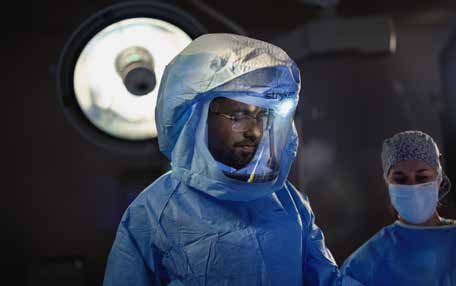
The orthopedic team brings together exceptional expertise and experience to deliver the best possible outcomes. All surgeons are fellowship trained, bringing cutting-edge orthopedics to the practice’s patient-centered model. The specialists cover a wide range of care – from roboticassisted surgery to personalized ankle and foot care.
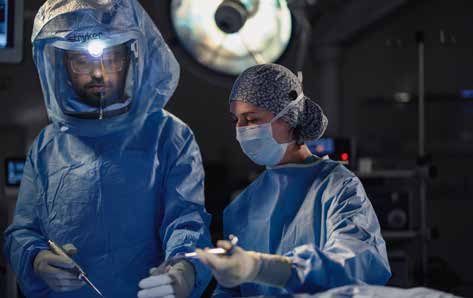 Dr. Akhtar, who is board certified, specializes in joint replacement and reconstruction. He completed his residency in orthopedic surgery at the Oklahoma State University – Center for Health Sciences in Tulsa. After finishing his residency, he spent an additional year completing an American Association of Hip and Knee Surgeons Fellowship in Hip and Knee replacement at Desert Orthopedic Center in Las Vegas, Nevada. Dr. Akhtar specializes in minimally invasive hip replacement, which reduces the size of surgical scars and expedites postoperative recovery. He performs direct anterior hip replacements and has an interest in partial knee arthroplasty and robotic assisted knee replacement. “My approach to medicine is rooted in empathy and respect. I treat every patient as I would want my own family to be treated. Listening is at the heart of my practice,” Dr. Akhtar said. “By truly hearing my patients’ concerns, we can build a personalized and effective care plan that supports their recovery and long-term well-being.”
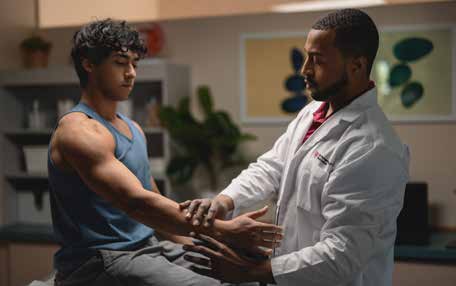 Dr. Murtaza brings his expertise in hip and knee surgery to the orthopedic team. He received his medical degree from SUNY Upstate Medical University in Syracuse. He completed a residency in orthopedics at Albany Medical Center, followed by a fellowship in adult reconstruction at NYU Langone Hospital in New York City.
He specializes in both primary and complex hip and knee replacements, and is adept at hip surgery, especially the direct anterior approach to optimize patient recovery. He also specializes in total and partial knee replacement, revision hip and knee surgeries, and general trauma injuries.
“There is no greater feeling than to see a patient come in, and over time, make the transition from a wheelchair to a walker to a cane, and then walking independently,” said Dr. Murtaza. “It has to be one of the more gratifying things to experience in all honesty. That’s the foundation of patient care.”
Dr. Angelicola-Richardson, who is boardcertified, focuses on issues of the upper extremity and wrist. He is a graduate of SUNY Upstate Medical University in Syracuse. He completed his orthopedic surgery residency at Albany Medical Center, where he gained extensive experience in trauma and reconstructive procedures. He further honed his skills through a prestigious fellowship in hand and upper extremity surgery at New York-Presbyterian/Columbia University Irving Medical Center in New York City, one of the nation’s leading programs in this specialty. He spent time at St. Peter’s during his residency, so he knew of the highquality, compassionate care offered by the clinicians at St. Peter’s.
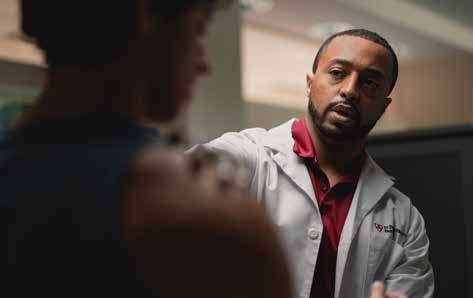 “It is an outstanding organization,” Dr. Angelicola Richardson said, “but, most importantly, the quality of care and the commitment to the community align with my responsibilities to my patients.” Before joining St. Peter’s Orthopedics, Dr. Angelicola-Richardson served patients at Rome Health in Rome, New York, where he was known for his compassionate care and meticulous surgical outcomes.
Kevin McCracken, MD, who is boardcertified, leads the spine care team. He has worked two decades as a spine surgeon, first at his own practice in New Jersey and then in Florida.
“St. Peter’s has everything I was looking for: the mission statement of providing for the community, plus working with a group of people covering every specialty,” he said. “We can treat the whole gamut; every aspect of care.”
In addition to his extensive surgical and academic training, McCracken has broad experience in the treatment of
adult and adolescent patients with spine disorders. McCracken firmly believes in his mission to care for each individual patient and their total well-being, taking pride in providing compassionate, understanding, and supportive care.
Over the past 25 years, he has completed more than 10,000 spine procedures ranging from minimally invasive procedures to complex reconstructive surgery for scoliosis and spinal deformity. He also has served as a spine trauma surgeon at a Level 1 Trauma Center for over 10 years.
Adel Mahjoub, MD, manages the foot and ankle care team. He earned his medical degree from the University of Pittsburgh School of Medicine in 2019. He went on to complete a five-year orthopedic surgery residency at Cooper University Hospital in Camden, New Jersey, where he developed a strong interest in foot and ankle pathology. He then pursued advanced fellowship training in foot and ankle surgery at Harvard Massachusetts General Hospital in Boston, Massachusetts, completing his fellowship in 2024.
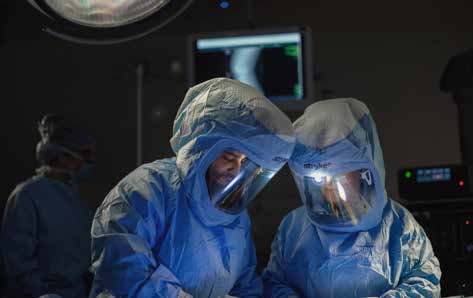 Dr. Mahjoub’s clinical expertise spans the full spectrum of foot and ankle care. He has specialized training in minimally invasive techniques, ankle arthroscopy, ankle fusion, total ankle replacement, flatfoot reconstruction, and bunion correction. He also treats a wide range of tendon and soft tissue conditions, including disorders of the Achilles and peroneal tendons.
“I focus on the care of sports injuries and arthritis, with an emphasis on minimally invasive techniques,” Dr. Mahjoub said. “It is deeply rewarding to apply my hands on skills to restore function, relieve pain, and support patients as they return to their daily lives.”
Board-certified Peter Shaughnessy, MD, leads the hand and wrist specialty program. He graduated valedictorian from the University at Buffalo School of Medicine and Biomedical Sciences and went on to complete his residency in orthopedic surgery at Dartmouth- Hitchcock Medical Center in New Hampshire. Dr. Shaughnessy then completed a fellowship in Hand and Upper Extremity Surgery at NYU Langone Health in New York City which included microvascular training.
Dr. Shaughnessy’s professional interests include complex upper extremity trauma, arthritic conditions of the hand and wrist, peripheral nerve surgery, and arthroscopy. He is board-certified and has more than 10 years of experience. “I wanted to join an employee owned orthopedic group,” Dr. Shaughnessy said, “and St. Peter’s is solidly behind us. The surgeons here can treat every orthopedic need. Our goal is to be a onestop shop for our patients. We’re excited for the future of orthopedics here and want everyone to know about it.”
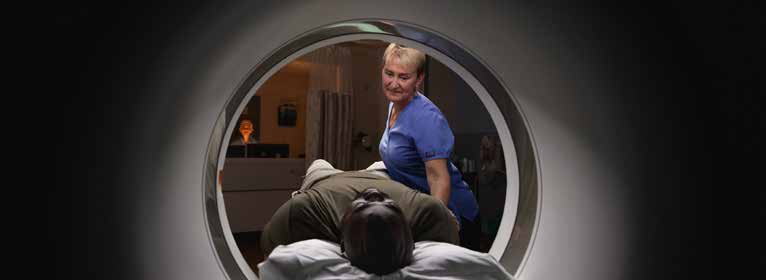
Seamless Care
A huge component of delivering seamless patient care is communication, both verbally and electronically. The EMR at St. Peter’s Health Partners Medical Associates facilitates the in-house sharing of information.
The orthopedic team works closely with primary care providers and hospitals throughout the Capital Region to coordinate patient care.
“We use the same network the hospital uses, the same system the primary care network uses -so we have seamless communication,” Dr. Murtaza said. “If the primary care doctor has questions, they can text me or send me a message on the same EMR. That goes a long way toward coordinating care. It avoids unnecessary tests and delays in patient care.”
Additionally, patients can access their medical records through Trinity Health’s MyChart application which is part of the EMR. This allows patients to make appointments, get test results, and communicate with their provider. The app can be accessed via the St. Peter’s website www.sphp.com/mychart.
Surgery and Rehabilitation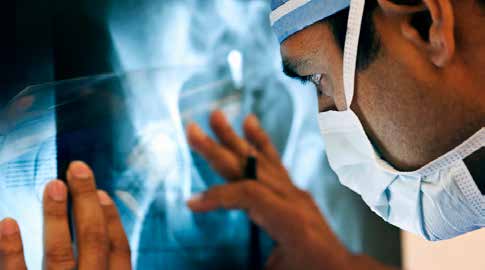 The surgical team uses the latest technologies and techniques to treat patients effectively. That means robotic assisted techniques for joint replacements, minimally invasive procedures, and advanced diagnostics.
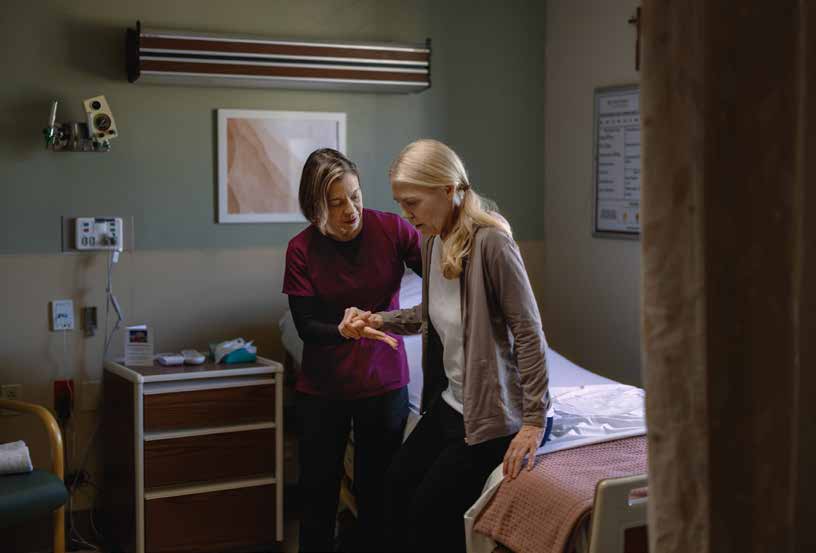
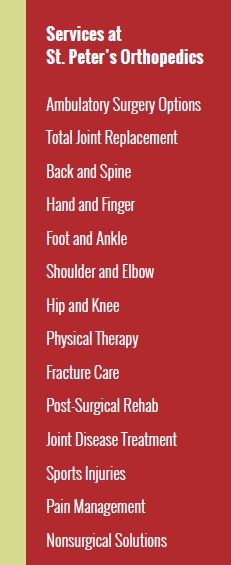
Not every orthopedic condition requires surgery. St. Peter’s Orthopedics follows a specific protocol for every patient: evaluation, therapy first, surgery when needed, and recovery and support. Non surgical options include joint disease treatment, physical therapy and rehabilitation, interventional pain management, bone health, platelet-rich plasma, shockwave, and electromyography.
 St. Peter’s Orthopedics works with Sunnyview Rehabilitation, which has 12 outpatient clinics throughout Albany, Saratoga, Schenectady, and Renssalaer counties, and is a member of St. Peter’s Health Partners.
Care at Sunnyview differs from most other physical therapy offices in at least two ways – a therapist will work with a patient one-on-one and, if needed, will treat a patient in their home.
“Every area of orthopedics relies on physical therapy. They truly work hand in hand. I tell my patients that therapy is often underutilized,” Dr. Murtaza said. “With consistency, physical therapy can ease many problems and help people improve without medication or surgery.” When surgery is the only remaining option, the surgeons at St. Peter’s Orthopedics are eager to help patients recover and get back to living their lives. “I love a practice where you are able to deliver care and see results pretty much right away,” said Dr. Akhtar. “After a fracture, you can set their broken bone and help them get moving again. You feel a little sense of accomplishment that you contributed to that healing.”
The physicians at St. Peter’s Orthopedics also meet regularly, to collaborate and share their expertise to maximize patient experience and outcomes.
“For those patients who have complicated and multiple issues, it’s very important that we communicate between staff and physicians,” said Dr. Angelicola-Richardson. “We maintain an open line of communication and that helps patients feel welcome and heard.”
St. Peter’s Orthopedics is located at 1182 Troy Schenectady Road, Suite 100, Latham. You may reach them at (518) 269-4690. Regular office hours are Monday through Friday, 8 a.m. to 4:30 p.m., and walk-in clinic hours are Monday through Friday, 8 a.m. to 4 p.m.
 I will not debate the politics behind the recent health care cuts, but I will share my concerns about their impacts.